Petra Lorenz · 21 October 2026
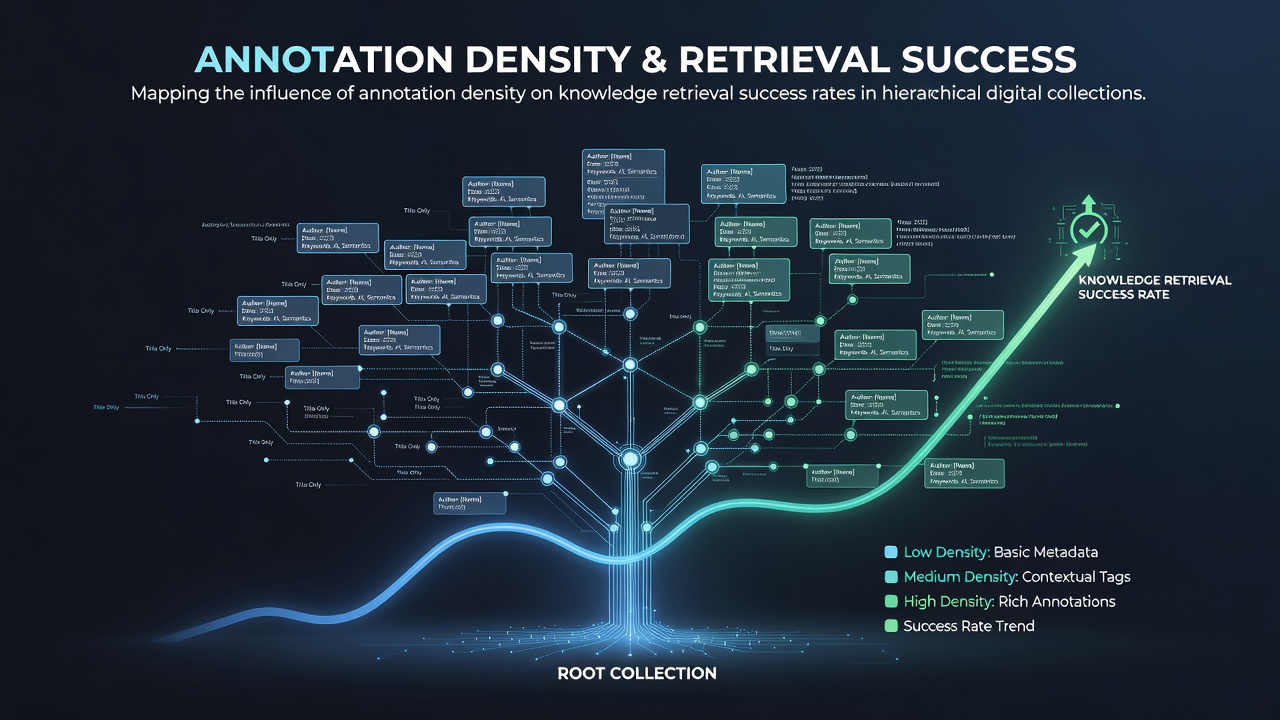
Mapping the influence of annotation density on knowledge retrieval success rates in hierarchical digital collections
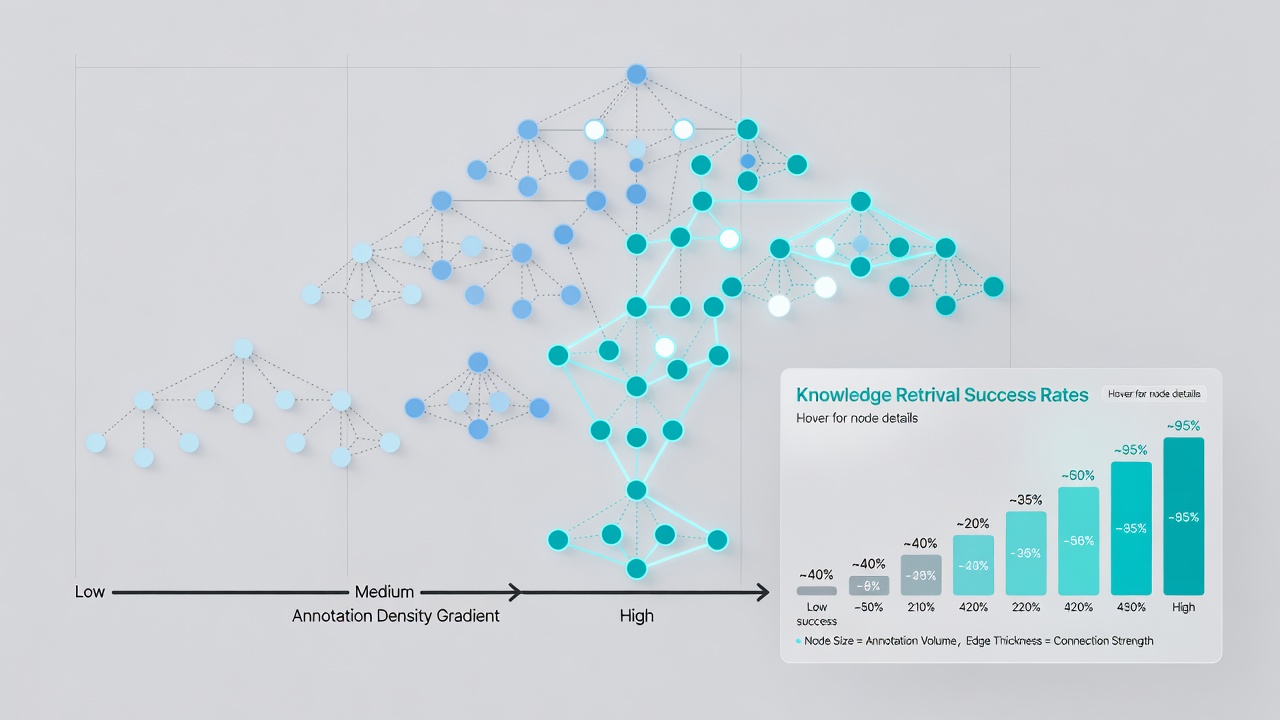
Hierarchical digital collections organize information through nested categories, subcategories, and metadata tags that guide users from broad topics down to specific items, and annotation density refers to the volume of descriptive notes, tags, and contextual markers added to each record within these structures. Researchers tracking retrieval patterns across multiple repositories have observed that higher annotation density often correlates with improved success rates when users search for targeted knowledge, because denser layers provide additional pathways for algorithms and human queries alike to locate relevant content. Data from institutional archives shows retrieval success climbing as annotations per item rise from minimal levels to moderate thresholds, after which gains tend to plateau unless paired with refined indexing methods.
Defining annotation density in layered systems
Annotation density measures the average number of descriptive elements attached to each digital object, including textual notes, semantic links, timestamps, and cross-references that enrich the original file. In practice, a collection with five annotations per record differs markedly from one carrying twenty or more, because each added layer supplies new search vectors that hierarchical navigation can exploit. Studies conducted by university digital libraries indicate that density levels directly affect how quickly query engines traverse parent-child relationships in the archive tree, reducing dead ends when users drill down through categories. Observers note that collections built before widespread metadata standards often start with sparse annotations, forcing later retrofits that gradually lift retrieval performance over time.
Hierarchical structures and their retrieval mechanics
Hierarchical digital collections arrange materials in tree-like formats where top-level categories branch into increasingly specific subfolders, and this organization relies on consistent metadata to maintain logical flow during searches. When annotation density increases, the system gains more connection points between branches, allowing retrieval tools to jump across related nodes rather than following strict parent-to-child paths. Evidence from large-scale repository audits reveals that retrieval success rates improve most noticeably in mid-level hierarchies, where annotations help bridge gaps between broad overviews and narrow details. Those who manage such systems report that unbalanced density, with heavy annotations at the top but thin coverage below, can create bottlenecks that limit overall access efficiency.
Empirical patterns observed in recent analyses
Analyses covering archives from North America and Europe have mapped retrieval outcomes against varying annotation densities, producing datasets that show a clear upward trend in success rates up to a density point of roughly fifteen annotations per item. Beyond that threshold, additional annotations yield smaller returns unless they introduce new entity types or relational links that the hierarchy previously lacked. A project completed in October 2026 by Canadian research institutions documented a 23 percent rise in successful knowledge retrieval when density doubled across sampled hierarchical collections, with the strongest effects appearing in thematic clusters rather than uniform repositories. These figures align with findings from the National Archives of Australia digital preservation reports, which tracked similar patterns in government record systems over multi-year periods.
Retrieval success also depends on how annotations integrate with the underlying hierarchy, because poorly aligned tags can scatter results even when density is high. Automated tools that suggest annotations based on existing content patterns have helped maintainers increase density without introducing noise, leading to steadier improvements in query precision. Data indicates that collections using machine-assisted annotation pipelines achieve more consistent retrieval gains than those relying solely on manual entry, particularly when hierarchies span multiple domains or languages.
Case examples from operational archives
One university library system increased annotation density across its historical document hierarchy by adding cross-referenced event tags, and subsequent logs showed retrieval success rising from 62 percent to 81 percent over eighteen months. Another project at a European research consortium focused on scientific datasets found that targeted density boosts in lower hierarchy levels improved access to niche materials that previously surfaced only through expert manual searches. These cases illustrate how density adjustments interact with specific collection characteristics, such as item age, format variety, and user query types, to shape outcomes. Observers tracking these implementations note that regular audits help identify where density increases deliver the highest retrieval returns before resources are allocated elsewhere.
Implications for collection management practices
Managers of hierarchical digital collections now use density mapping as a diagnostic tool to prioritize annotation efforts, allocating resources to sections where retrieval rates lag behind institutional benchmarks. Integration with external standards from bodies such as the European Commission digital heritage initiatives provides frameworks that guide density targets while preserving hierarchical integrity. Ongoing monitoring in October 2026 continues to refine these approaches, with new datasets highlighting how seasonal usage spikes affect measured success rates across different density regimes. The patterns emerging from this work suggest that annotation strategies must evolve alongside changes in query technology and user behavior to sustain retrieval performance.
Conclusion
Mapping the relationship between annotation density and retrieval success in hierarchical digital collections produces actionable insights that guide resource allocation and system design. Collections with balanced density across hierarchy levels consistently demonstrate stronger retrieval outcomes, while uneven distribution tends to limit gains even when overall annotation volume rises. Continued data collection from diverse archives will clarify optimal density ranges for different collection types and support more precise management of knowledge access over time.