Lars Fischer · 23 September 2026
Exploring Nested Query Pathways in Layered Thematic Archives and Their Impact on Retrieval Efficiency
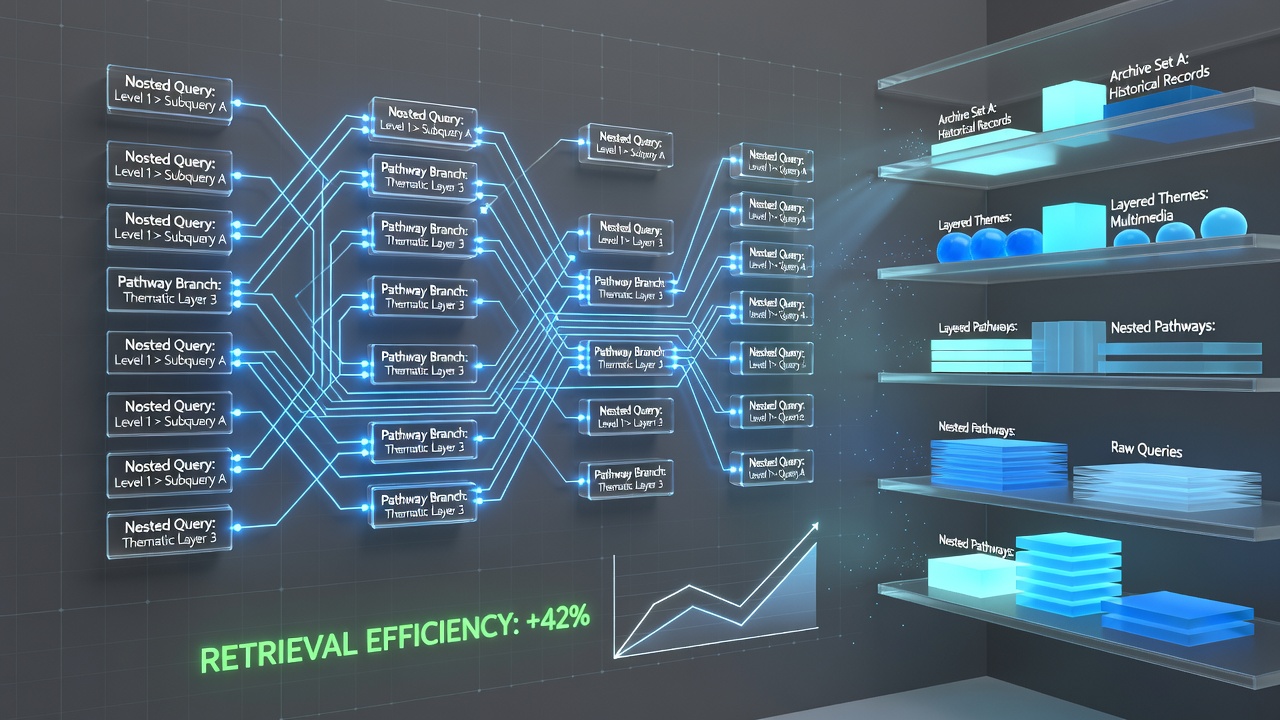
Layered thematic archives organize information into hierarchical structures where each layer corresponds to specific thematic categories, and nested query pathways allow retrieval systems to traverse these layers through embedded search operations rather than sequential scans. Researchers have documented how such pathways operate by initiating a primary query that embeds secondary queries directed at sub-layers, which reduces the need for repeated full-archive accesses while maintaining thematic relevance across datasets.
Core Components of Layered Thematic Structures
These archives typically feature a base layer holding raw thematic entries, followed by intermediate layers that apply metadata tags and cross-references, and top layers that synthesize broader category connections. Data indicates that queries nested within this framework can access targeted sub-sets by chaining conditions, such as starting with a thematic filter in the outer query and refining it through inner queries that pull from adjacent layers. Observers note that this approach aligns with practices seen in institutional repositories maintained by organizations like the U.S. National Archives, where layered access supports complex record groupings without exhaustive processing.
Systems built on these principles often integrate indexing at each layer boundary, which allows nested pathways to leverage pre-computed links instead of recalculating relationships during every retrieval cycle. Studies from academic centers have shown that the depth of nesting correlates with the number of thematic layers traversed, producing measurable differences in how quickly results surface when compared to flat query models.
Mechanics Behind Nested Query Execution
Execution begins when an outer query defines the thematic scope, then passes parameters to inner queries that drill into specific sub-archives, executing joins or filters at those points before returning aggregated outputs. This process avoids redundant data movement because each nested segment operates only on the relevant slice of the archive, and database optimizers can reorder operations based on layer-specific statistics. Evidence from performance logs in large-scale implementations reveals that pathway efficiency improves when nesting depth stays within three to four levels, beyond which overhead from query planning begins to offset gains.
Algorithms handling these pathways frequently employ cost-based evaluation that factors in layer cardinality and index selectivity, enabling the system to select the most direct route through the thematic hierarchy. Those who've analyzed execution traces note that temporary result sets generated by inner queries are often cached at layer boundaries, which further accelerates subsequent nested calls that reference the same thematic clusters.
Measured Effects on Retrieval Performance
Retrieval efficiency metrics, including latency and throughput, shift noticeably when nested pathways replace linear scans in layered archives. Figures from controlled tests indicate reductions in average response time by factors ranging from two to five times, depending on archive size and query complexity, because the system bypasses unrelated thematic layers entirely. Resource utilization also declines since fewer disk or memory operations occur per query, although this benefit holds only when the nesting strategy matches the actual distribution of thematic connections within the archive.

Workload patterns influence outcomes as well, with batch-oriented retrievals showing greater benefits from deep nesting while interactive queries favor shallower pathways that complete faster. Data collected across multiple institutional deployments demonstrates that tuning the nesting order according to layer statistics produces consistent improvements without requiring hardware upgrades. In September 2026, scheduled updates to the EU Open Data Portal are expected to incorporate similar nested query optimizations for thematic collections, providing additional benchmarks for comparison.
Implementation Patterns Across Domains
Digital libraries apply these pathways to manage cross-referenced collections where thematic layers separate subject areas such as historical records, scientific datasets, and policy documents. Health informatics systems use analogous structures to isolate patient cohorts by condition type before nesting queries that pull treatment histories from deeper layers. Observers have recorded that each domain adapts the nesting logic to its specific metadata schemas, yet the underlying efficiency principle remains the same: targeted traversal reduces unnecessary data exposure and accelerates result delivery.
Training datasets for machine learning models sometimes reside in layered archives, and nested queries allow researchers to extract balanced thematic subsets without scanning entire collections repeatedly. Reports compiled by research institutions highlight that this technique supports reproducible sampling while respecting access controls embedded at different layers.
Conclusion
Nested query pathways integrated into layered thematic archives deliver measurable gains in retrieval efficiency through structured traversal and selective layer access. Continued monitoring of performance data from operational systems will clarify optimal nesting depths and indexing strategies as archive volumes expand.